Ph.D. in Civil Engineering · University of Windsor

Ran Wang

Computational engineer turning physics-based simulation into engineering insight: CFD · FEA · Molecular Dynamics · HPC

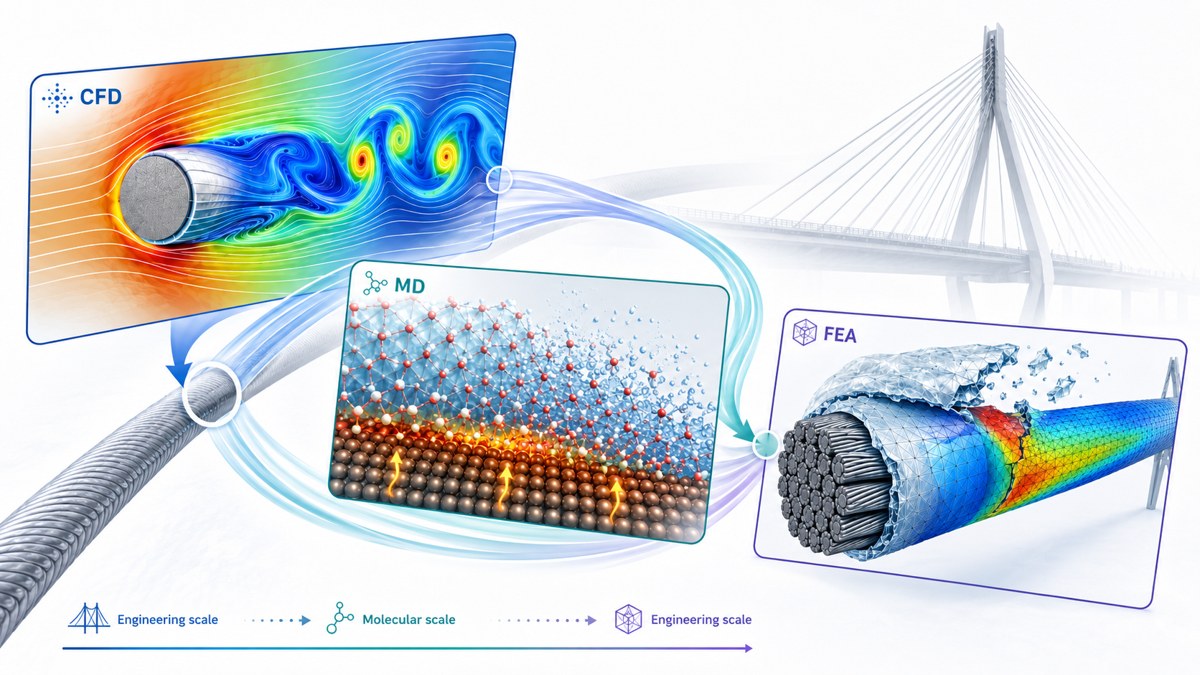
8+ years building, validating, and analyzing large-scale simulations of fluid dynamics, structural mechanics, and molecular systems. My doctoral work established a multi-scale computational framework for the two main weather-driven hazards of bridge stay cables: wind-induced vibration and ice accretion & detachment.

9peer-reviewed journal articles
6international conference papers
3first-author papers in Physics of Fluids
10yrsimulation & wind-tunnel experience

01 Research Themes

My research connects three scales of physics (turbulent flow around structures, molecular behaviour of ice, and continuum fracture mechanics) into one predictive framework for cable-stayed bridge safety.

Bluff-Body Aerodynamics & Cable Galloping

High-fidelity DES/DDES simulations (OpenFOAM) of flow around yawed and inclined circular cylinders. Revealed how the leeward axial flow intermittently interacts with von Kármán vortex shedding, the low-frequency excitation believed to drive large-amplitude dry inclined cable galloping on bridges.
Molecular Dynamics of Ice

LAMMPS simulations of ice melting and adhesion on metal and polymer substrates, in collaboration with the National Research Council Canada. Benchmarked SPC/E, TIP3P and TIP4P water models, quantified melting-front kinetics with the tetrahedral order parameter, and compared CPU vs GPU performance.

Multi-Scale Ice-Detachment Prediction

Fed MD-derived, temperature-dependent ice–HDPE adhesion into a cohesive-zone finite element model of an ice-accreted stay cable. Identified a narrow thermal window near 268 K where ice debonding becomes possible, and showed that wind direction, not suction magnitude alone, governs whether wind promotes or resists detachment.

02 Publications

First author on all publications except the invited 2023 ISDAC keynote. Each entry shows a key figure from the paper.

Graphical abstract: CFD, molecular dynamics, and FEA linked across scales for stay-cable wind and ice hazards Multi-scale framework: CFD → MD → FEA
2026Ph.D. Dissertation

Computational Analysis of Wind- and Ice-Driven Hazards of Stay Cables on Long-Span Cable-Stayed Bridges

R. Wang · University of Windsor (defended May 6, 2026)

A three-part dissertation integrating nine published or submitted papers: (I) CFD of wind-induced unsteady aerodynamic response of dry inclined cables; (II) molecular dynamics of ice melting and adhesion on silver and HDPE substrates; (III) a multi-scale FE model predicting thermally- and wind-driven ice detachment from cable sheaths.

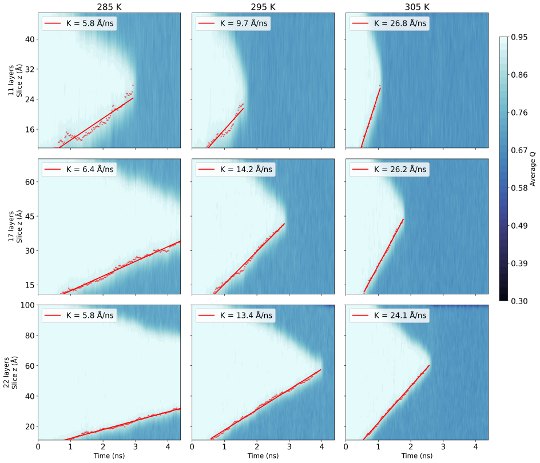
Layer-resolved kymographs tracking the melt front of ice on a silver substrate at three temperatures Melt-front tracking on silver at 285–305 K
2026Journal

Molecular dynamics study of ice melting on a silver plate

R. Wang, S. Cheng, D. S-K. Ting, A. Raeesi, S. McTavish, A. D'Auteuil · Journal of Chemical Physics

With the National Research Council: TIP4P/ice simulations of an ice cube melting on an atomically flat silver slab, tracked with the tetrahedral order parameter under a layer-resolved Langevin thermostat. Substrate temperature controls the melt; doubling ice thickness roughly triples melt time, and basal-plane contact loses crystalline order faster than prism-plane contact.

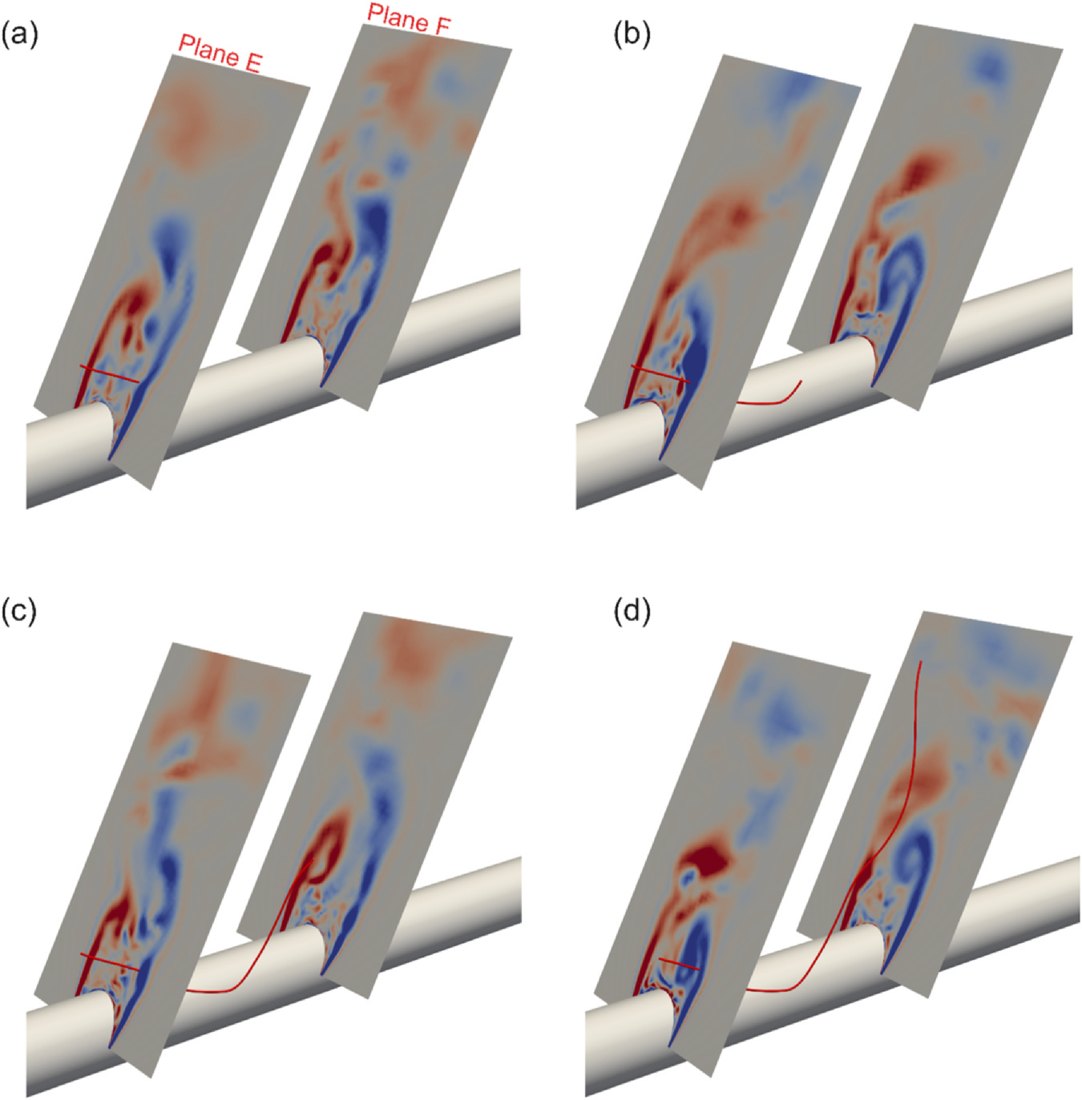
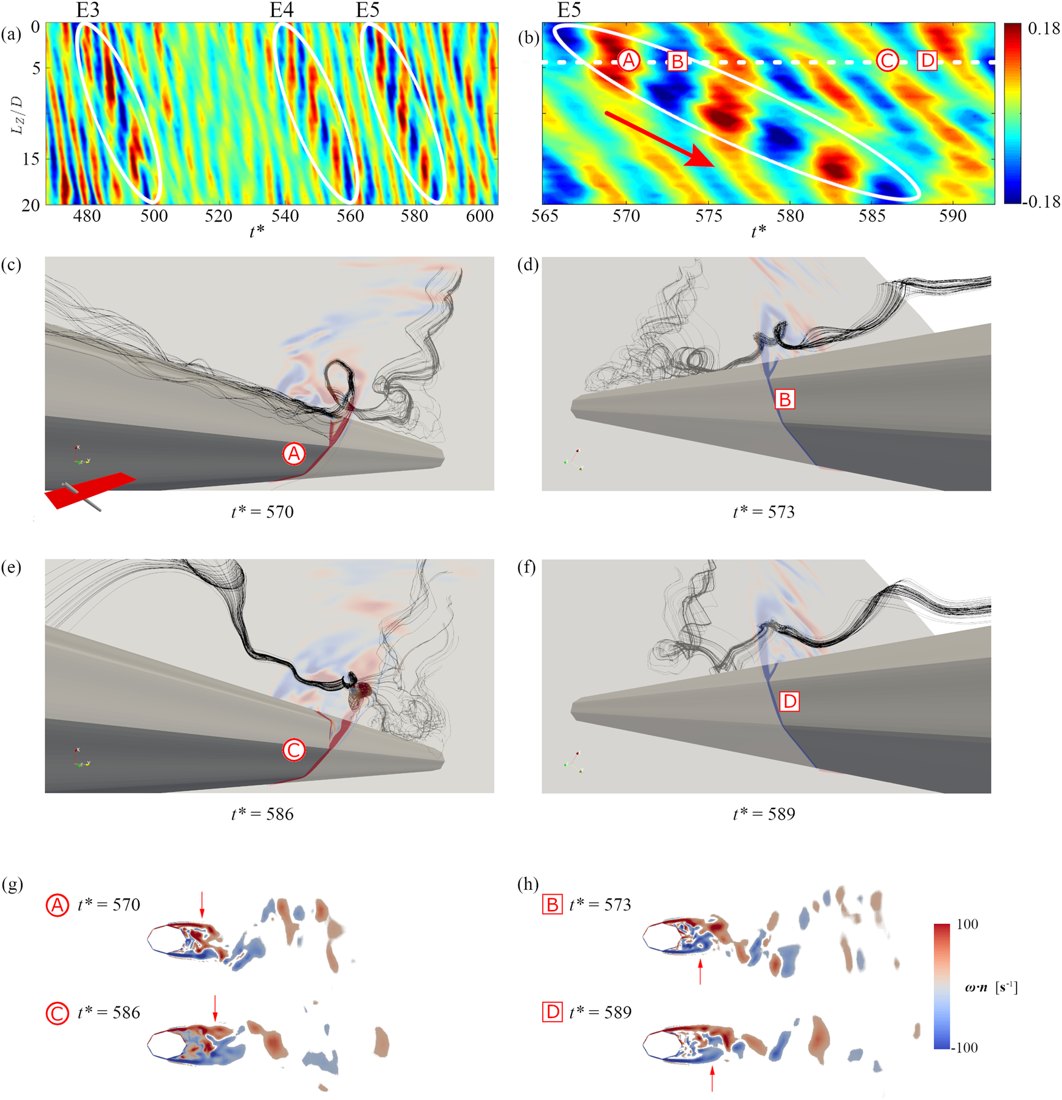
Vorticity on planes along an inclined cylinder with axial flow trajectory Axial-flow / Kármán-vortex interaction on an inclined cable
2025Journal · Invited

Explore generation mechanisms of unsteady large-amplitude wind-induced response in stay cables by delayed detached eddy simulation

R. Wang, S. Cheng, D. S-K. Ting · Advances in Wind Engineering, 2(4): 100085

DDES shows the leeward axial flow intermittently amplifying vortex shedding, with sectional lift propagating along the span in an S-shaped wavy pattern, the source of the low-frequency component of unsteady cable response observed on bridges.

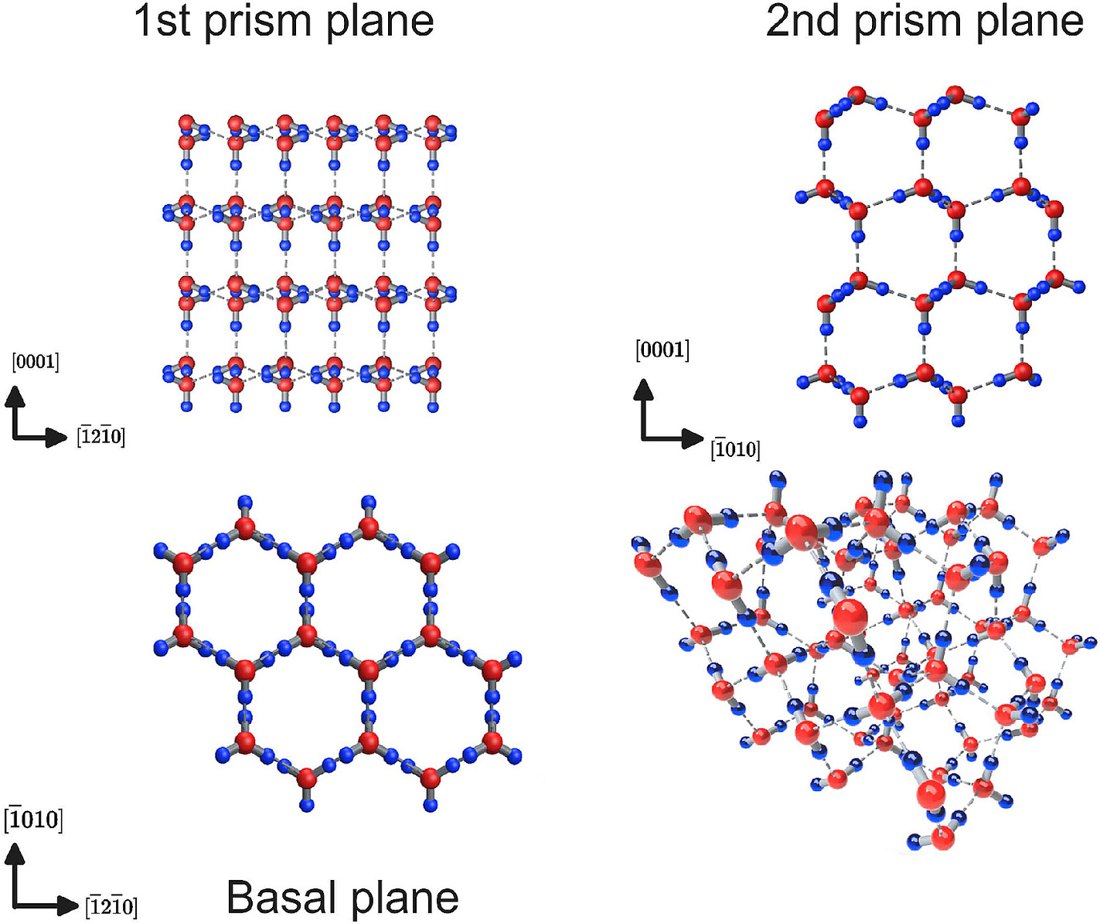
Ice crystal structure viewed along prism and basal planes Ice Ih crystal: prism & basal planes, ordered vs molten
2025Journal

Ice crystal structure melting: insights from molecular dynamics simulations

R. Wang, S. Cheng, D. S-K. Ting, A. Raeesi, S. McTavish, A. D'Auteuil · Cold Regions Science and Technology, 237: 104528

With the National Research Council: LAMMPS simulations of the ice-to-water transition tracked by the tetrahedral order parameter. Evaluates SPC/E, TIP3P and TIP4P water models for melting behaviour, stability and cost, plus CPU/GPU benchmarking, groundwork for predicting ice shedding from bridge cables.

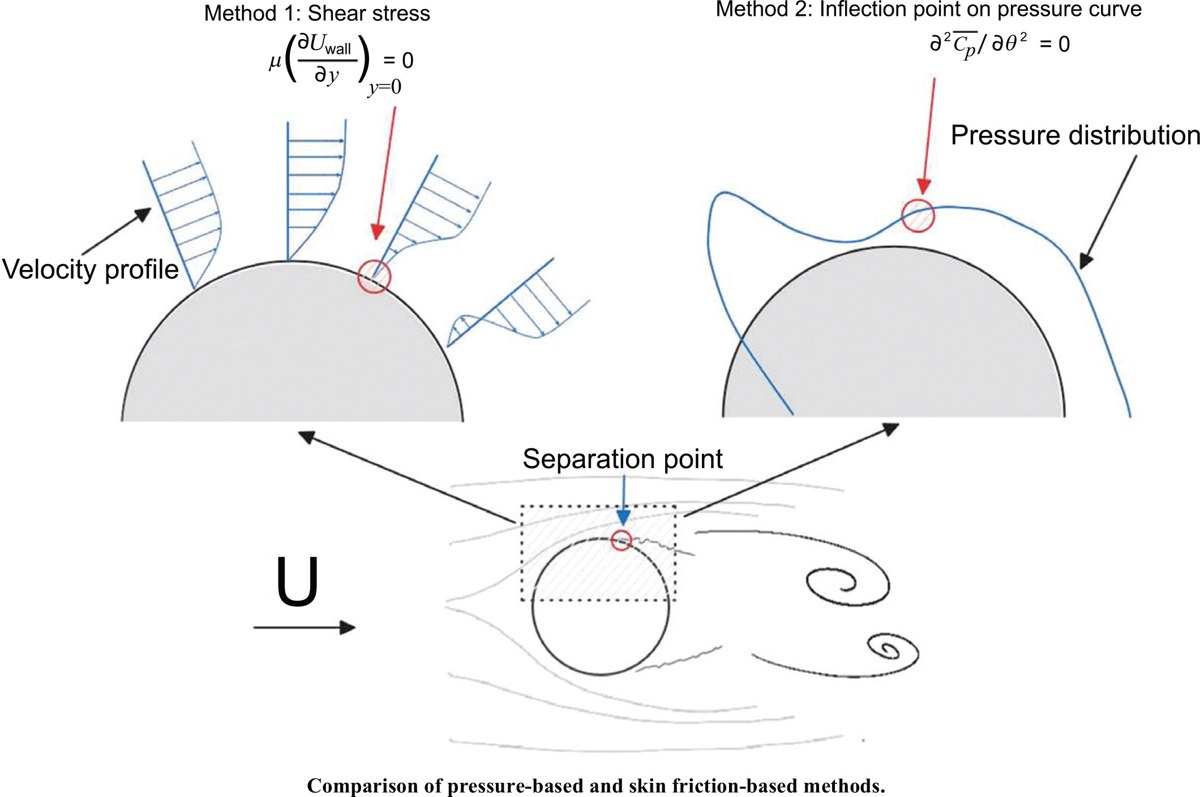
Graphical abstract comparing shear-stress and pressure-inflection methods for locating the separation point on a cylinder Two ways to locate the separation point: skin friction vs pressure inflection
2024Journal

Comparison of pressure-based and skin friction-based methods for the determination of flow separation of a circular cylinder with roundness imperfection

R. Wang, S. Cheng, D. S-K. Ting · Current Chinese Science, 4(3): 159–180

DDES at Re = 100–10⁴ shows separation on an imperfectly round cylinder can be triggered either by an adverse pressure gradient or by a gentle bend in the cross-section, and that the common pressure-based criterion needs flow-visualization verification at high Re.

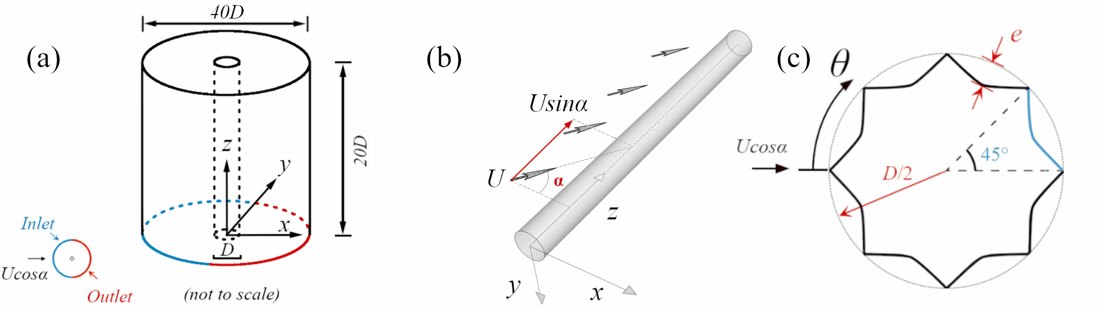
Computational domain and ridged octagonal cross-section schematic Domain & "ridged" cross-section (4% roundness imperfection)
2024Conference

Impact of Attack Angle on Low-Frequency Aerodynamic Response of a Ridged Circular Cylinder

R. Wang, S. Cheng, D. S-K. Ting · 9th Int. Colloquium on Bluff Body Aerodynamics & Applications (BBAA IX), Birmingham, UK

Attack-angle sweep (0–45° in 5° steps) at Re = 10⁴ uncovers a low-frequency lift pattern near 30°, with intermittently enhanced correlation between the axial vortex and Kármán shedding, a candidate excitation for unstable cable motion.

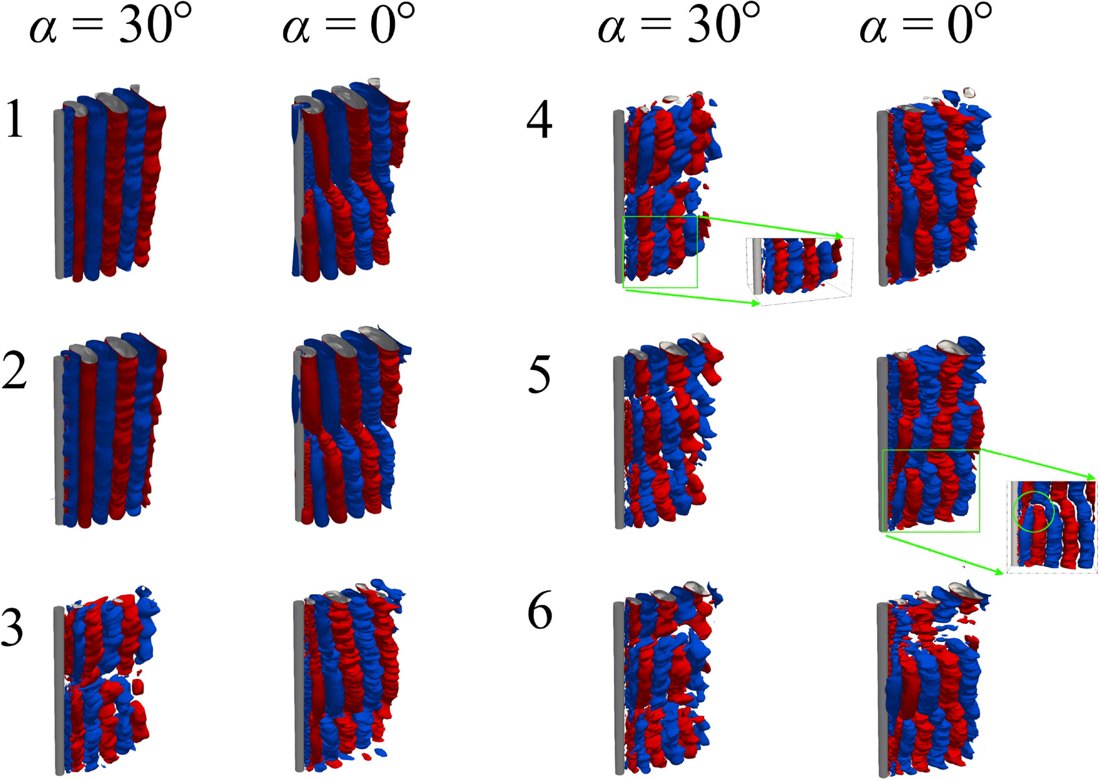
POD modes: 3D iso-surfaces of coherent structures along yawed and normal cylinders POD modes: coherent span-wise structure, 30° vs 0° yaw
2023Journal

Numerical study of flow characteristics around a 30° yawed circular cylinder at Re = 10⁴

R. Wang, S. Cheng, D. S-K. Ting · Physics of Fluids, 35: 105134

Proper orthogonal decomposition reveals a synchronized anti-symmetric pressure-block structure and a low-frequency fluctuation at ~¼ of the Kármán Strouhal number, a periodic excitation that could contribute to dry cable galloping.

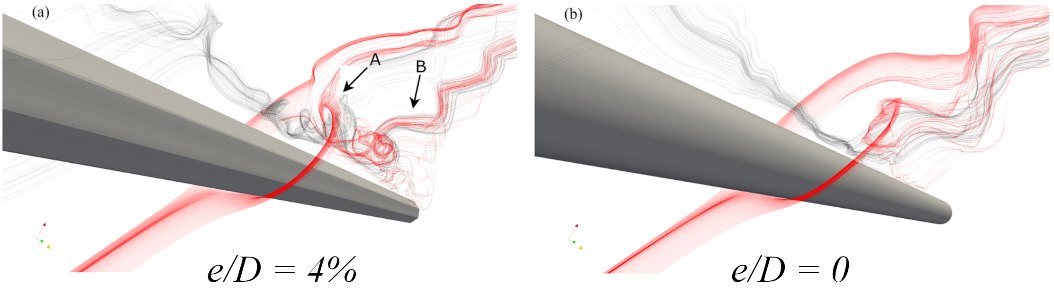
Streamlines wrapping a coned cylinder, smooth vs ridged Axial-flow ribbons: ridged (e/D = 4%) vs smooth cable
2023Invited Keynote

Explore essential elements in the generation mechanisms of wind-induced cable vibrations: An insight offered by numerical techniques

S. Cheng, R. Wang · Dynamics and Aerodynamics of Cables (ISDAC 2023), Springer, pp. 3–15

Keynote synthesis of the group's DDES findings: why instability appears only at certain cable orientations, and how imperfect roundness traps axial flow near the surface, strengthening its interaction with Kármán vortices.

3D vortex structures around a cylinder with roundness imperfection Axial vortex retained along the leeward surface (4% imperfection)
2020Journal

Numerical study of roundness effect on flow around a circular cylinder

R. Wang, S. Cheng, D. S-K. Ting · Physics of Fluids, 32: 044106

A realistic 4% roundness imperfection shortens the recirculation zone and retains more axial flow near the leeward surface, where it intermittently amplifies transverse lift at low frequency, identifying shape imperfection as a possible excitation source for dry inclined cable galloping.

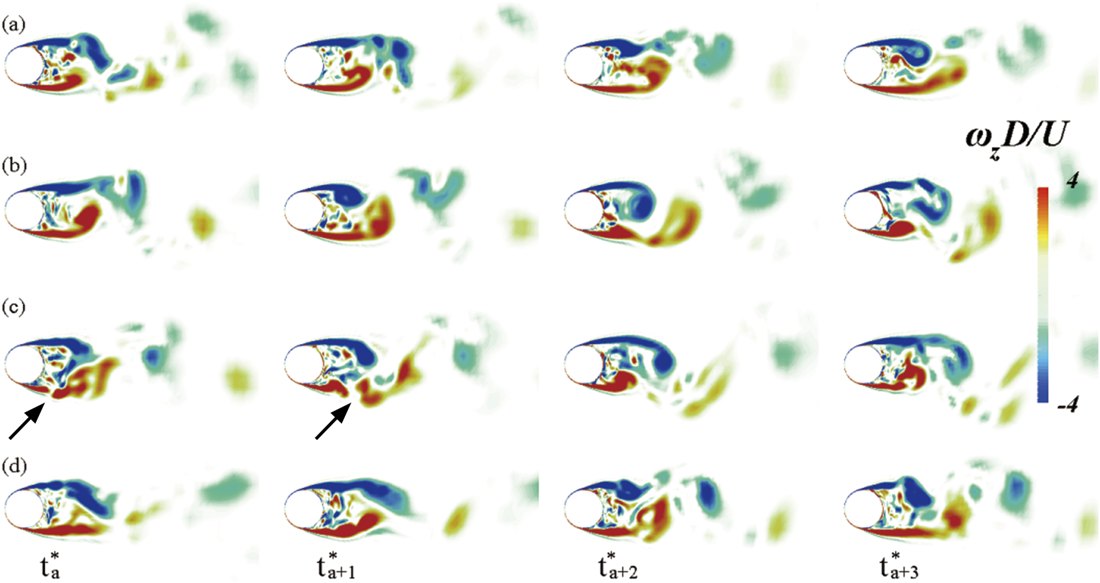
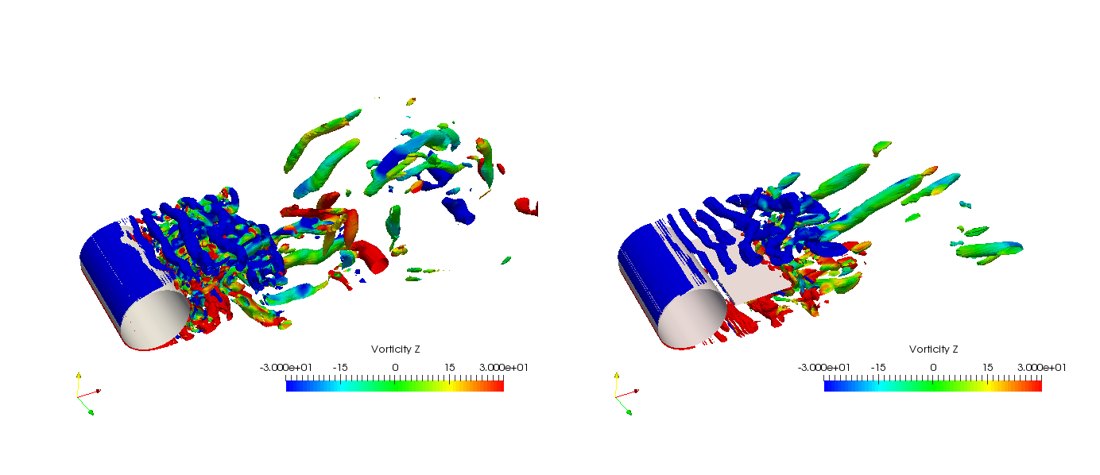
Time sequence of vorticity contours around yawed cylinder sections Vortex shedding staggering in time along the cylinder axis
2019Journal

Effect of yaw angle on flow structure and cross-flow force around a circular cylinder

R. Wang, S. Cheng, D. S-K. Ting · Physics of Fluids, 31: 014107

DDES at Re = 1.4×10⁴ for yaw angles 0–60°: local vortex shedding staggers along the axis, producing near-zero span-wise averaged lift; Kármán shedding is mitigated above 30° yaw, and the Independence Principle holds for Strouhal number but not for other flow properties.

Q-criterion vortex structures behind a cylinder with perforated splitter plate Wake structures vs splitter-plate perforation ratio (LES, Re = 3900)
2018Book Chapter

Simulating the role of axial flow in stay cable vibrations via a perforated wake splitter plate

R. Wang, S. Cheng, D. S-K. Ting · Wind Engineering for Natural Hazards: Modeling, Simulation, and Mitigation of Windstorm Impact on Critical Infrastructure (ASCE), Ch. 6, pp. 111–132

Models axial flow indirectly: a perforated splitter plate in the cylinder wake (LES, perforation ratios 0–1) interrupts shear-layer interaction the way axial flow does, weakening Kármán shedding and reducing fluctuating lift and drag.

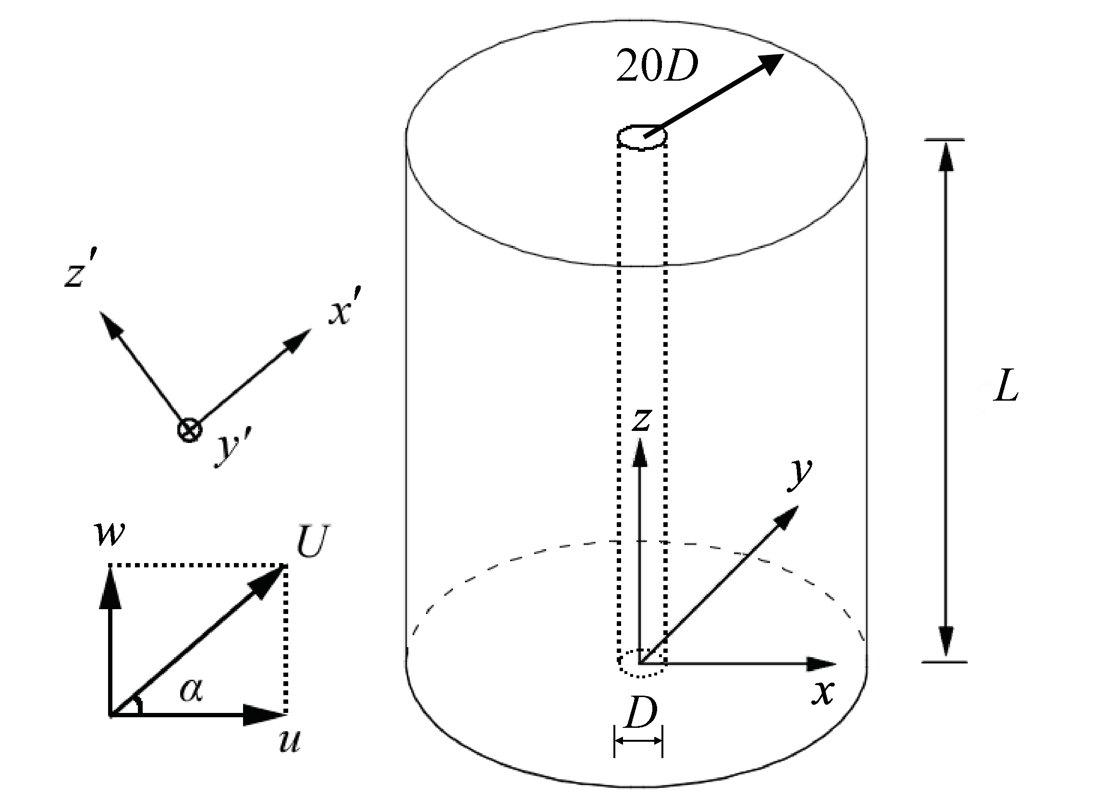
Computational domain and leeward axial-flow visualizations from the MASc thesis Inclined-cylinder domain & leeward axial-flow formation
2018M.A.Sc. Thesis

Numerical Simulations on Flow Around an Inclined Circular Cylinder at High Reynolds Number

R. Wang · University of Windsor

DES/LES across Re = 3,900–2.8×10⁵ and attack angles 0–60°: inclination generates a secondary axial flow on the leeward side and near-zero span-averaged lift via span-wise delay of sectional forces, with lift becoming disorganized in the critical Re regime.

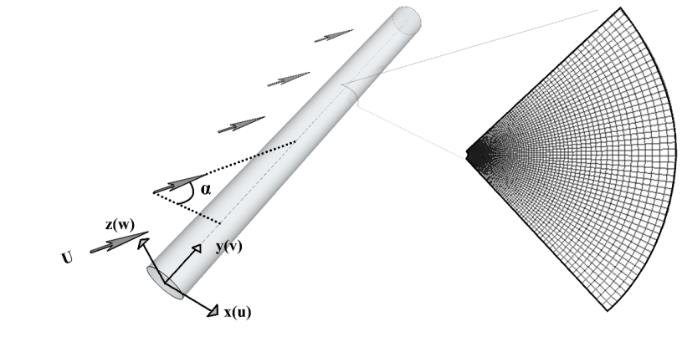
Inclined cylinder schematic with O-grid mesh Inclined-cylinder model & O-grid mesh (DES, Re = 10⁵)
2017Conference

Numerical study on flow structure around an inclined circular cylinder at Re = 10⁵

R. Wang, S. Cheng, D. S-K. Ting · Int. Symposium on the Dynamics and Aerodynamics of Cables (ISDAC 2017), Porto, pp. 283–290

DES in OpenFOAM of cylinders inclined 0–75°: visualizes leeward axial-flow formation, reshaped near-wake recirculation, and tests the validity of the Independence Principle at high Reynolds number.

03 Engineering Projects

Hands-on experimental and design work in the University of Windsor wind tunnel laboratories.

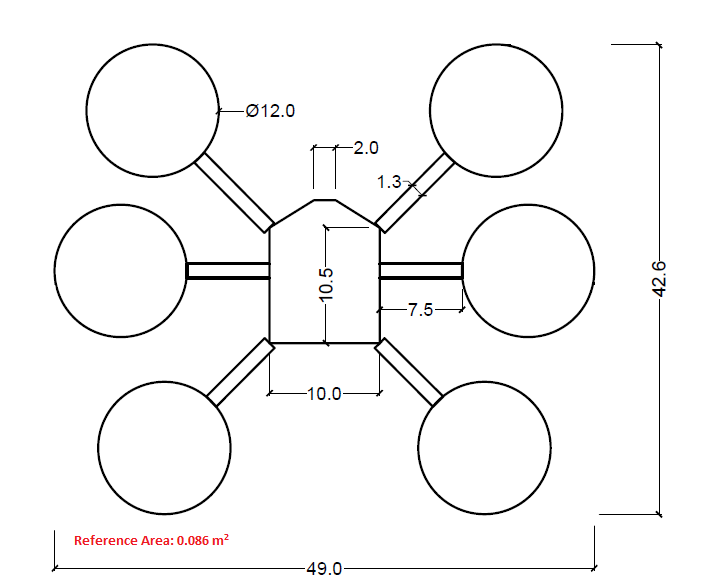
Plan-view engineering drawing of the hexacopter drone model, 49 x 42.6 cm, reference area 0.086 m2
2016Wind Tunnel Testing · Project Lead

Aerodynamic Force Testing of a Hexacopter Drone

Led a three-person team testing an industrial partner's six-rotor drone model in the wind tunnel, measuring drag, lift, and pitching-moment coefficients with a six-axis force–torque sensor across pitch angles, yaw angles (0–90°), propeller-tilt configurations, and four wind speeds.

  • Root-caused a measurement problem like an experimentalist: when force readings fluctuated, designed rod-only baseline tests that repeated within ~1%, proving the tunnel and sensor were sound and isolating the fault to the model–support connection.
  • Iterated the mounting design with the lab technician (reinforcement piece, through-bolts) and re-tested, honestly documenting residual pitch-up deformation at the 13.75 m/s maximum speed.
Phase-1 assembly animation (Shapr3D)
2016Mechanical Design · CAD

Wind Tunnel Model Support System: Design to Fabrication

Co-designed a custom rig to mount a 1.42 m acrylic cylinder in the CFI open-loop wind tunnel: twin floor-standing columns, octagonal frames with ball-jointed rotating arms for adjustable inclination, Ø360 mm end plates for two-dimensional flow, and spring suspension for dynamic (free-vibration) testing.

  • Full design cycle: SolidWorks part/assembly modeling → dimensioned manufacturing drawings → sourced bill of materials (McMaster-Carr / OnlineMetals part numbers) → fabrication coordination with the machine shop.
  • Ran a documented two-person design review: every purchased item independently cross-checked against the drawings for dimensional fit and quantity before ordering.
  • Recently rebuilt the assembly in Shapr3D for visualization (render and animation shown here).

04 Skills & Tools

CFD

  • OpenFOAM (DES / DDES / LES)
  • ANSYS Fluent
  • Bluff-body aerodynamics
  • Proper orthogonal decomposition

FEA & Structural

  • ABAQUS, ANSYS, LS-DYNA
  • Static / modal / dynamic analysis
  • Cohesive-zone fracture models
  • Classical hand-calculation verification

Molecular Dynamics

  • LAMMPS
  • Water models (SPC/E, TIP3P, TIP4P)
  • Ice adhesion & melting kinetics
  • GPU-accelerated MD

Programming

  • Python (automation, post-processing)
  • C++ · MATLAB · Bash
  • CUDA-accelerated workloads
  • Reproducible analysis pipelines

HPC & Visualization

  • Digital Research Alliance of Canada clusters
  • Large-scale parallel runs (4M+ cells)
  • ParaView
  • Custom Python visualization

Experimental & CAD

  • Wind tunnel testing
  • Force–torque sensors, Pitot-static, hot-wire anemometry
  • SolidWorks, Shapr3D
  • Test-rig design & commissioning

Pursuing P.Eng. licensure (PEO)

05 Education

2021 – 2026

Ph.D., Civil Engineering · University of Windsor

Dissertation: Computational Analysis of Wind- and Ice-Driven Hazards of Stay Cables on Long-Span Cable-Stayed Bridges · defended May 6, 2026 · all degree requirements met

Aerodynamics of Bluff Bodies · Earthquake Engineering · Turbulent Flow

2016 – 2018

M.A.Sc., Civil Engineering · University of Windsor

Thesis: Numerical Simulations on Flow Around an Inclined Circular Cylinder at High Reynolds Number

Finite Element Methods · Wind Engineering · Structural Dynamics · Theory of Stability · Flow Measurement

2011 – 2015

B.Sc., Civil Engineering · Shandong University, China

06 Contact

Open to opportunities in computational engineering, R&D, aerodynamics, and simulation.